

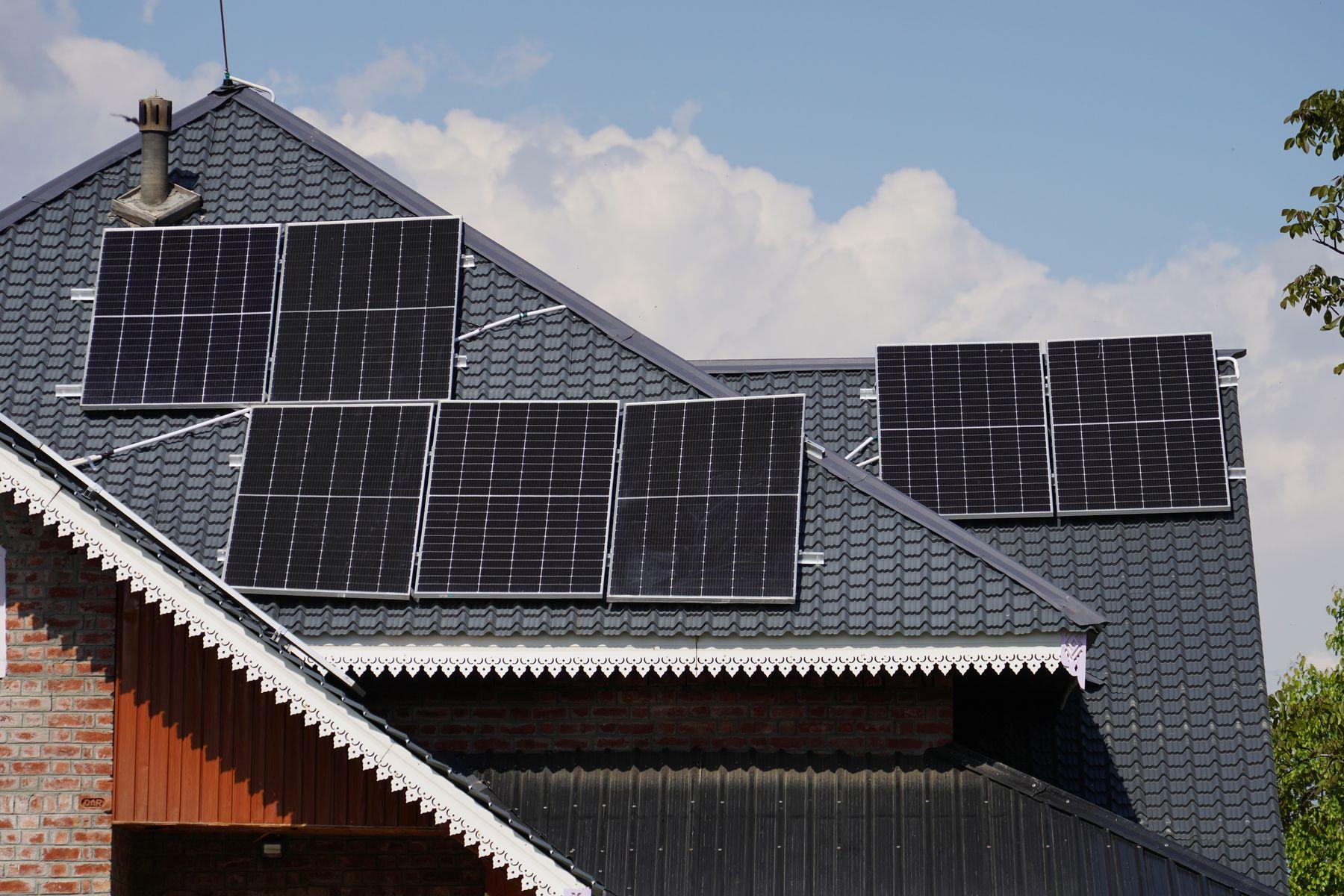
Residential Rooftop Solar
1–10 kW on-grid rooftop systems for homes and housing societies, with PM Surya Ghar subsidy filing handled end to end.
Read more
Grid-tied for maximum savings, off-grid for remote sites, or hybrid with batteries for power-cut-proof homes.
The right system type depends on how reliable your grid supply is, whether you need backup, and your budget. We help you choose honestly, even if that means the cheaper option.
All three types use the same high-efficiency panels; the difference lies in the inverter and whether batteries are included.
Lowest cost per kW, net-metering credits and eligible for PM Surya Ghar subsidy. No batteries needed.
Panels + batteries + off-grid inverter. Complete energy independence where grid supply is absent or unreliable.
Grid-tied savings plus lithium battery backup that switches over automatically in milliseconds during a power cut.
Start on-grid today and add batteries later. We size inverters and wiring with future storage in mind.
| Feature | On-Grid | Off-Grid | Hybrid |
|---|---|---|---|
| Grid connection | |||
| Battery backup during power cuts | |||
| Net-metering credits | |||
| PM Surya Ghar subsidy (residential) | Panels only* | ||
| Upfront cost | Lowest | Highest | Medium–High |
| Best for | Cities with reliable supply | Remote sites, farms | Frequent outages |
*Subject to scheme guidelines and DISCOM approval. We confirm eligibility during the site survey.
Straight answers on cost, subsidy, generation and maintenance.
If your area rarely has power cuts, on-grid gives the best return. If you face regular outages, a hybrid system costs more but keeps essential appliances running without a separate inverter-battery setup.
PM Surya Ghar subsidy applies to grid-connected residential rooftop systems. Hybrid systems that are grid-connected may qualify for the panel portion; we confirm eligibility during the survey.
Lithium-ion (LFP) batteries typically last 8–12 years or 4,000–6,000 cycles. Tubular lead-acid batteries last around 4–6 years with regular maintenance.
An on-grid system works with the electricity grid and exports surplus power, giving the lowest cost and the best savings, but it switches off during power cuts. An off-grid system runs on batteries with no grid connection. A hybrid system is grid-connected and also has batteries, so it saves on bills and gives backup during outages.
If you have a grid connection, a hybrid system is usually the best choice: it lowers your bill and keeps essential loads such as lights, fans and Wi-Fi running during outages. Off-grid makes sense only where the grid is unavailable or very unreliable.
Batteries are the main extra cost. Depending on how much backup you need and the battery type, a hybrid or off-grid system usually costs noticeably more than an on-grid system of the same size. We size the battery for your essential loads only, so you don't pay for backup you won't use.
It depends on the load you want to run and for how long. As a rough guide, running 1 kW of essential load for 4 hours needs about 4–5 kWh of usable battery capacity. We list your essential appliances during the survey and recommend a battery size to match.
Yes. Your existing panels can be reused; we add a hybrid inverter or a battery-ready inverter with batteries. If you expect to need backup later, ask for a battery-ready design at the start to keep the upgrade simple and cheaper.
1–10 kW on-grid rooftop systems for homes and housing societies, with PM Surya Ghar subsidy filing handled end to end.
Read more
10 kW to multi-MW plants for factories, offices, schools, hospitals and warehouses, engineered for the fastest ROI.
Read more
Diesel-free irrigation with AC/DC solar pumps from 1 HP to 10 HP, with PM-KUSUM scheme assistance for farmers.
Read moreFree Quote · No Obligation
Tell us a little about your property. A solar engineer will call you within 24 hours.
Plot No. 65, Siddarth Enclave, Delhi Road, Sonipat, Haryana 131001
Mon – Sat: 9:30 AM – 7:00 PM